
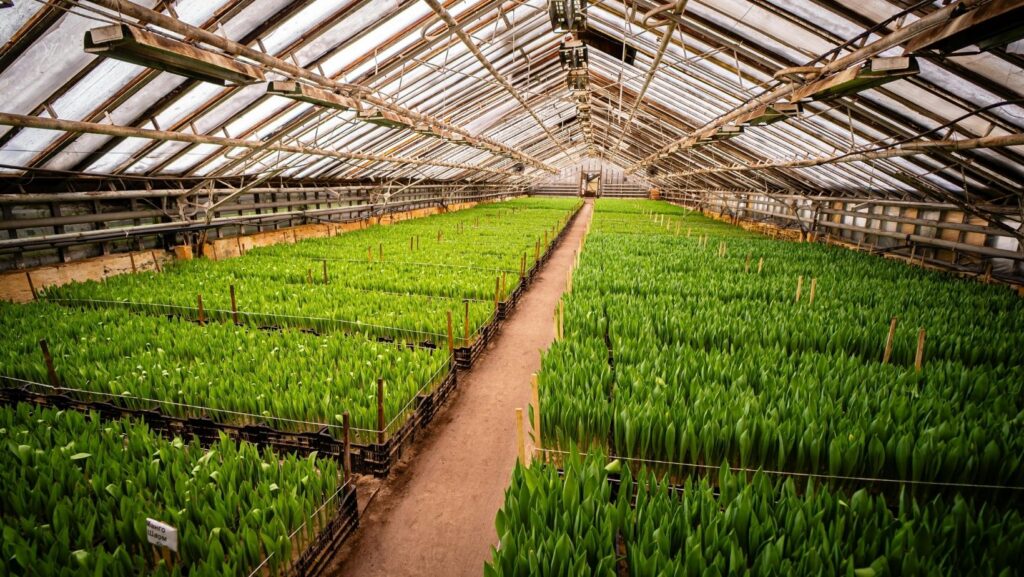
A greenhouse is only as productive as the environment inside it. Temperature, light, and nutrition all receive considerable attention in commercial growing operations, but humidity is equally fundamental to plant health, yield consistency, and disease prevention. A greenhouse humidifier gives growers precise control over the moisture levels that drive transpiration, nutrient uptake, and overall crop development, and without it, even the most carefully managed growing program will fall short of its potential.
Key Takeaways:
- Relative humidity between 50% and 80% is the optimal range for most greenhouse crops
- Inadequate humidity causes wilting, stunted growth, and reduced yield, while excess moisture promotes fungal disease and root rot
- High-pressure fogging and evaporative systems are the most widely used and effective humidification methods in commercial greenhouse environments
- Humidification systems should be zoned and automated to respond to real-time conditions across different areas of the greenhouse
- Proper airflow integration is essential to distribute moisture evenly and prevent condensation on plant surfaces and structural components
Why Humidity Is a Foundational Variable in Greenhouse Growing
Plants regulate their internal temperature and move water and nutrients through a process called transpiration, the release of water vapor through leaf stomata. This process is directly governed by the vapor pressure deficit (VPD) between the plant’s internal moisture and the surrounding air. When the air is too dry, stomata close to conserve water, halting nutrient transport and effectively pausing growth. When humidity is correctly maintained, transpiration flows freely, and plants reach their genetic growth potential.
In a sealed or semi-sealed greenhouse environment, the grower has full control over this variable. That control, exercised through a well-designed humidification system, is one of the most powerful tools available for maximizing productivity per square foot.
Vapor Pressure Deficit and Its Role in Plant Health
Vapor pressure deficit (VPD) is the difference between the amount of moisture the air currently holds and the maximum it could hold at a given temperature. It is a more precise metric than relative humidity alone because it accounts for temperature, which directly affects how much moisture air can carry.
| VPD Range (kPa) | Plant Response | Growth Stage Suitability |
| 0.0 – 0.4 | Stomata open wide, high disease risk | Propagation, cuttings |
| 0.4 – 0.8 | Optimal transpiration, strong growth | Seedlings, early vegetative |
| 0.8 – 1.2 | Balanced transpiration and water use | Vegetative to early flowering |
| 1.2 – 1.6 | Increased water demand, potential stress | Late flowering, fruiting |
| Above 1.6 | Stomatal closure, growth suppression | Not recommended for most crops |
Managing VPD rather than relative humidity alone gives commercial growers a more accurate framework for dialing in conditions at each stage of the crop cycle.
Common Humidity Challenges in Greenhouse Environments
Greenhouses face humidity challenges from multiple directions simultaneously. External climate conditions, internal heat generation from lighting and equipment, crop density, and ventilation all interact to create a constantly shifting humidity profile that passive management cannot adequately address.
Seasonal Humidity Fluctuations
In colder months, heated greenhouses draw in dry outside air, driving internal humidity down sharply. Growers relying on passive moisture sources like watering, plant transpiration alone cannot compensate for this loss at scale. In warmer months, the challenge reverses: high outdoor humidity combined with reduced ventilation can push internal RH above safe levels, creating conditions favorable to fungal pathogens.
Uneven Humidity Distribution
Large greenhouse structures frequently develop humidity gradients — zones near vents or doors where air exchanges rapidly may be significantly drier than interior zones with dense canopy cover. Without active distribution, these gradients persist and result in inconsistent growth across the facility.
Disease Pressure From Humidity Extremes
Both ends of the humidity spectrum invite disease. Excessively dry conditions stress plants, weaken their natural defenses, and make them more susceptible to spider mites and other pests that thrive in dry environments. Excessively wet conditions, particularly stagnant moisture on leaf surfaces create ideal conditions for botrytis, powdery mildew, and downy mildew. Precision humidification targets the range between these extremes.
How Greenhouse Humidifiers Work
Several humidification technologies are used in commercial greenhouse environments. The best choice depends on the size of the facility, the crops being grown, the climate zone, and the level of control required.
High-Pressure Fogging Systems
High-pressure fogging systems pressurize water and deliver it through engineered nozzles to create fine droplets that evaporate into the air under proper distribution conditions. When designed correctly, this method increases humidity while minimizing surface wetting.
As water evaporates, it absorbs heat from the surrounding air, creating an adiabatic cooling effect. This makes high-pressure fogging suitable for managing both humidity and temperature during warm growing periods.
Evaporative Pad Systems
Evaporative pad systems draw outside air through water-saturated media before it enters the greenhouse. As air passes through the pads, it absorbs moisture and cools through evaporation. This approach is commonly used in hot, dry climates.
Because airflow moves directionally from pads to exhaust fans, temperature and humidity levels may vary across the structure, requiring careful layout planning in larger facilities.
Ultrasonic Humidifiers
Ultrasonic systems use high-frequency vibration to create fine droplets without adding heat. They are often applied in smaller zones, propagation chambers, or specialty crop areas where localized control is required. Water quality management is essential to prevent mineral deposition on plants or equipment.
Centrifugal Atomization Systems
Centrifugal humidifiers spin water at high speed to break it into droplets that are dispersed by an integrated fan. These systems are commonly used for supplemental or temporary humidification in targeted areas.
Optimal Humidity Ranges by Crop Type
Different crops have different humidity requirements, and within a single crop, those requirements shift across growth stages. A well-designed greenhouse humidification system accommodates these variations through zoning and programmable control schedules.
| Crop Category | Vegetative Stage RH | Flowering/Fruiting RH | Notes |
| Leafy Greens (lettuce, spinach) | 60–75% | 55–70% | Sensitive to tip burn at low RH |
| Tomatoes | 65–75% | 60–70% | Reduce RH during fruit set to prevent cracking |
| Cucumbers | 70–85% | 65–80% | High humidity tolerance; watch for mildew |
| Peppers | 60–70% | 55–65% | Prefer moderate, stable humidity |
| Herbs (basil, mint) | 55–70% | 50–65% | Airflow important to prevent fungal issues |
| Cannabis | 65–80% | 40–55% | Sharp RH reduction needed at late flowering |
| Orchids | 55–75% | 55–75% | Consistent humidity critical throughout cycle |
| Propagation (all crops) | 80–95% | N/A | High RH reduces transplant shock |
Designing a Greenhouse Humidification System
A humidification system that performs well in one greenhouse configuration may be entirely inadequate in another. System design must account for the specific physical and operational characteristics of each facility.
Calculating Humidification Capacity
The moisture output required to maintain target humidity levels depends on the volume of the greenhouse, the rate of air exchange, the heat load from lighting and climate equipment, and the transpiration rate of the crops being grown.
Undersized systems struggle to reach target RH during peak demand periods, while oversized systems risk over-humidification and condensation.
Zoning for Multi-Crop or Multi-Stage Facilities
Greenhouses growing multiple crop types simultaneously, or managing crops at different growth stages, benefit significantly from zoned humidification. Independent control of humidity levels in separate sections allows each zone to maintain the conditions most appropriate for the crops it contains without compromising neighboring zones.
Nozzle Layout and Spacing
In high-pressure fogging systems, nozzle placement determines how evenly moisture is distributed across the growing area. Nozzles should be spaced to provide overlapping coverage without creating zones of excessive concentration. Height placement matters as well, nozzles positioned too low may wet plant canopies before droplets fully evaporate.
Integration With Ventilation and Climate Control
Humidification systems must work in coordination with ventilation, heating, and cooling equipment. Introducing moisture into a space with inadequate air circulation will result in uneven distribution and condensation on structural surfaces. Climate controllers that manage all environmental variables from a single interface provide the most consistent results.
Preventing Disease Through Humidity Management
Disease prevention is one of the most compelling reasons to invest in precise humidity control. Fungal pathogens are the primary disease threat in most greenhouse environments, and the conditions under which they thrive; stagnant, moist air and wet plant surfaces are entirely within the grower’s ability to manage.
Key Strategies for Disease Prevention
- Maintain airflow alongside humidification to prevent moisture from settling on leaf surfaces, particularly at night when temperatures drop and condensation risk increases.
- Avoid humidifying during the dark period unless VPD management requires it, as plants transpire less at night and excess moisture accumulates more readily.
- Monitor leaf surface temperature relative to air dew point to identify conditions where condensation is likely before it occurs.
- Use horizontal airflow fans within the canopy to keep air moving and break up localized humidity pockets that form in dense plantings.
- Schedule humidity reduction periods ahead of morning temperature drops to reduce the risk of condensation forming as the greenhouse cools overnight.
Automation and Control Systems for Greenhouse Humidifiers
Manual humidity management is impractical in any commercial greenhouse operation. Conditions change throughout the day as outdoor temperatures shift, solar radiation varies, and crop transpiration rates fluctuate. Automated control systems maintain target humidity levels continuously without requiring constant operator attention.
Environmental Controllers
Dedicated greenhouse environmental controllers monitor temperature, humidity, VPD, and CO₂ levels simultaneously and adjust connected equipment (humidifiers, vents, fans, and heaters) to maintain programmed setpoints. These systems can be configured with crop-specific profiles that automatically adjust target conditions as crops move through growth stages.
Remote Monitoring and Alerts
Modern humidification control systems support remote monitoring via web interfaces or mobile applications, allowing facility managers to review real-time conditions, receive alerts when parameters drift outside acceptable ranges, and make adjustments without being physically present in the greenhouse.
Data Logging for Crop Optimization
Environmental data logs provide a record of the conditions crops experienced throughout their growth cycle. This data is valuable for diagnosing performance issues, comparing yields across cycles, and refining humidity programs for future crops based on observed outcomes.
Maintenance Requirements for Greenhouse Humidifiers
| Component | Maintenance Task | Recommended Frequency |
| Nozzles | Inspect for clogging; clean or replace | Monthly |
| Filters | Replace inline water filters | Per manufacturer schedule |
| Pump and pressure lines | Check for leaks and pressure consistency | Monthly |
| Sensors | Calibrate humidity and temperature sensors | Every 3–6 months |
| Distribution lines | Flush to remove mineral deposits and biofilm | Quarterly |
| Control system | Review setpoints and alarm configurations | Each crop cycle |
| Reservoir or water supply | Check for contamination or algae growth | Weekly |
Greenhouse environments are inherently humid and biologically active, which accelerates wear on humidification components compared to many other industrial settings. More frequent inspection intervals are appropriate for high-production facilities operating year-round.
Energy Efficiency Considerations
Commercial greenhouse operations run continuously, and energy costs are a significant operational concern. Humidification system selection and management directly affect the facility’s overall energy consumption.
High-pressure fogging systems consume relatively little electricity compared to steam-based alternatives, as the primary energy input is the pump rather than a heating element. The adiabatic cooling effect they produce also reduces the load on active cooling systems during warm periods, providing an indirect energy benefit.
Evaporative pad systems similarly offer low energy operation, though their effectiveness diminishes in humid climates where the air approaching the pads already carries significant moisture.
Pairing any humidification system with demand-based automation, which means running the system only when sensor readings indicate humidity has dropped below target, prevents unnecessary operation and reduces both energy use and maintenance wear.
Conclusion
A greenhouse humidifier is one of the most productive investments a commercial grower can make. By maintaining the precise humidity and VPD conditions that support vigorous growth, efficient nutrient uptake, and strong disease resistance, a well-designed humidification system directly translates into higher yields, better crop quality, and more consistent production outcomes across every growing cycle.
The key to maximizing that investment lies in matching the right technology to the facility, integrating it properly with ventilation and climate control, automating it for consistent performance, and maintaining it on a disciplined schedule. When all of these elements are in place, humidity becomes a managed asset rather than an unpredictable variable.
Frequently Asked Questions
What is the ideal humidity level for a greenhouse?
Most greenhouse crops thrive when relative humidity is maintained between 50% and 80%, though the optimal range shifts depending on crop type and growth stage. Many commercial growers also manage vapor pressure deficit (VPD) alongside relative humidity, with a VPD range of 0.8 to 1.2 kPa generally considered ideal for crops in the vegetative to early flowering stage.
What type of humidifier works best in a commercial greenhouse?
High-pressure fogging systems are the most widely adopted method in commercial greenhouses, producing droplets small enough to evaporate instantly without wetting plant surfaces or pooling on the floor. Evaporative pad systems are another effective option in hot, dry climates, while ultrasonic and centrifugal systems work well for smaller sections or targeted supplemental humidification.
How does poor humidity control affect greenhouse crops?
When humidity is too low, plant stomata close to conserve water, halting nutrient transport and leading to wilting, stunted development, and reduced yields. When humidity is excessively high and moisture becomes stagnant on leaf surfaces, conditions become ideal for fungal pathogens such as botrytis, powdery mildew, and downy mildew.
Should a greenhouse humidification system be automated?
Yes, manual humidity management is impractical in commercial greenhouse operations because conditions change continuously as outdoor temperatures shift, solar radiation varies, and crop transpiration rates fluctuate. Dedicated environmental controllers can monitor temperature, humidity, VPD, and CO2 simultaneously, adjusting connected equipment to maintain programmed setpoints without constant operator attention.
How often does a greenhouse humidifier need maintenance?
Nozzles and pump pressure lines should be inspected monthly, distribution lines flushed quarterly, and humidity sensors calibrated every three to six months. Water reservoirs should be checked weekly for contamination or algae growth, as greenhouse environments are biologically active and accelerate wear on humidification components.